Chapter 11
Projects, approvals and conflict
You don't run the church alone. Big building work, calling a pastor, and leaving the denomination all need the approval of whoever your tradition says decides, and some changes, above all taking out cherished pews, start a fight. This chapter explains who decides in each tradition, how they make up their minds, and how to get your way without losing people.
What needs approval
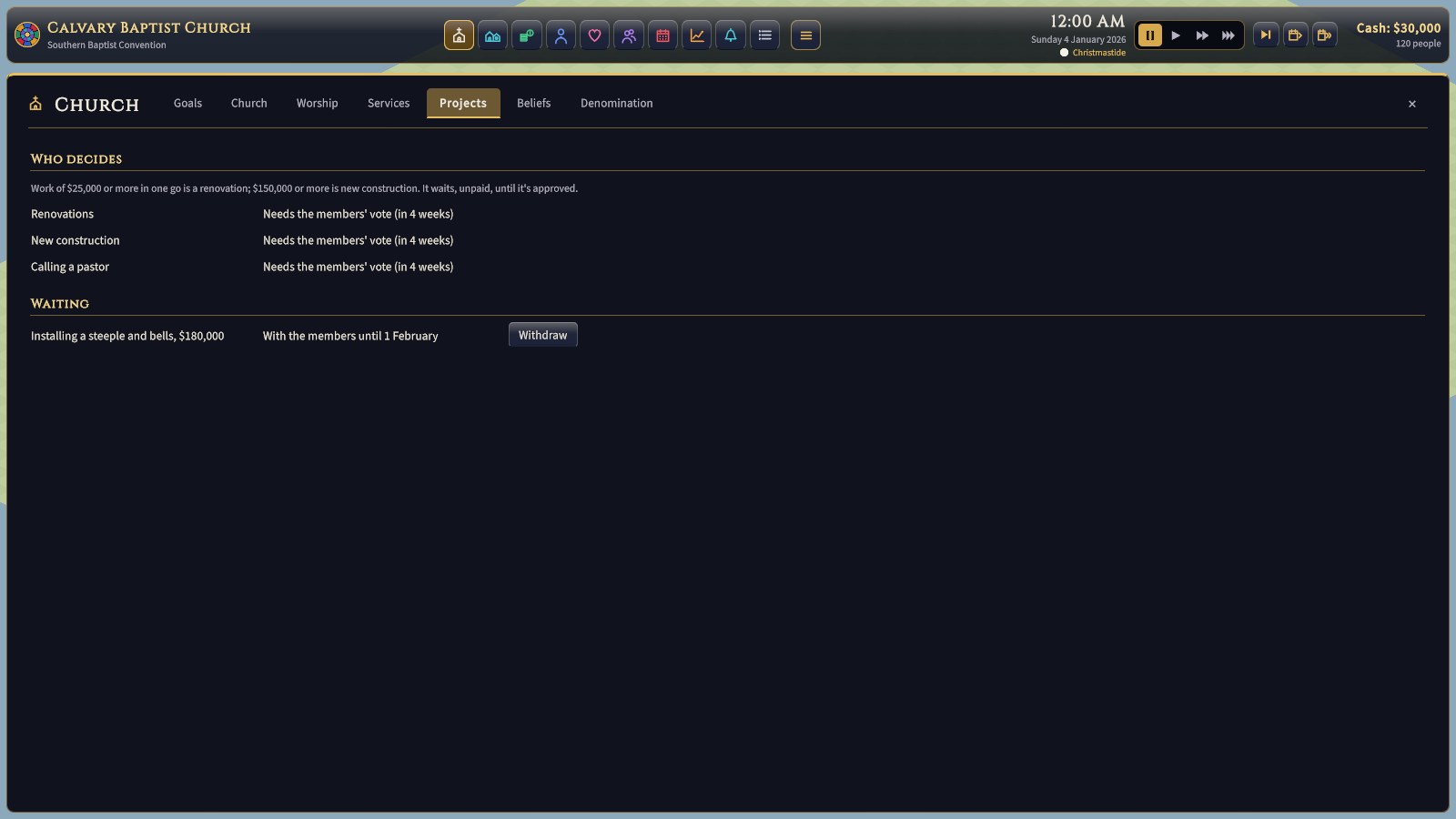
Once the church is open, building work of $25,000 or more in one go needs approval. Work of $25,000 or more is a renovation; work of $150,000 or more is new construction. A single item, however dear (an organ, a steeple), counts as a renovation. Where the pastor or priest decides renovations alone, without anyone's advice, renovations simply go ahead.
A church that starts on an empty lot, as a sandbox does, needs no approval until it first passes the building check. Buying more land always does.
Three other things wait as proposals too: calling a pastor, where your church calls its own (see Staff and volunteers); leaving the denomination (see Traditions, beliefs and stances); and adopting a designation such as Open and Affirming (see Traditions, beliefs and stances).
The building preview tells you before you commit, for example: "Needs the members' vote (in 4 weeks); paid for only if approved." Until it's decided, the work waits as a proposal, unpaid, and can be withdrawn from Church → Projects. If by the time it's decided the work can't be done as proposed, or the candidate you called has gone, it lapses.
Who decides
| Who | How | When |
|---|---|---|
| The pastor or priest | Decides alone, or with a board's advice | At once; a week on where a board advises |
| A board (council, session, vestry, trustees, elders) | Its seven longest-serving eligible members vote | Two weeks on |
| The members | Every member of 16 and over who votes, votes | Four weeks on |
| The wider body (diocese, district, conference, presbytery) | Reviews the finances and standing | Six weeks on |
Where a second approver must consent, it decides after the first has said yes, taking its own time on top: a members' vote with the presbytery's consent takes four weeks and then six more.
Boards
- By remit. A project goes to the board whose work covers it: building to the trustees or property committee, a call to the elders or deacons. Failing that, it goes to a board over everything (the church council, the session, the vestry), or to any board that decides.
- Who sits on it. The board is the seven longest-serving of the members who may hold office and whom the tradition makes eligible. Some say more: men only where women may not govern (or where it's left to the church and it doesn't ordain women), married men (the elders of a Church of Christ), tithers where office requires the tithe (a household counts if it pledges at least half of what it could give), or those who've signed the confession (Christian Reformed officebearers, after two years). Where nobody qualifies, the board is drawn from everyone who may hold office.
- Boards that only advise. Where the board advises (a Catholic parish's finance council), the pastor decides with its advice, and turns the work down if most of the board is against it.
- A pastor who doesn't govern (a Friends United Meeting pastor, a Church of Christ minister, Christian Science Readers) leaves to the board or the members what a pastor would decide elsewhere.
- Members who don't vote. Where no kind of belonging votes (a Catholic or Ukrainian Catholic parish, the Coptic Orthodox, Latter-day Saints, Witnesses, the Salvation Army, Churches of Christ, the nondenominational church, Calvary Chapel, Vineyard, ARC, a contemporary Christian church), what would go to the members goes to the board.
Thresholds, consensus, and advice
- Majority carries most votes. Some need more: two thirds to call a pastor in the Assemblies of God, ELCA, Nazarene, and Pentecostal Holiness churches, and for Unitarian Universalist new construction; 60% for Assemblies of God new construction; 90% to call a Unitarian Universalist minister. A vote that falls short says so: "voted for it, 52 to 38, short of the 67% it needed".
- Consensus (the Friends; the elders of a Church of Christ) carries only if no more than a tenth stand against it.
- A strong pastor's view sways the members or board where the pastor's authority is strong (the Assemblies of God, AME, Episcopal, National Baptist, Pentecostal Holiness, United Pentecostal, Vineyard, ARC, and nondenominational churches): a skilled pastor adds up to 0.2 to each voter's support for building work, a weak one takes it away.
- A consulted board's mood sways a vote it doesn't take itself: a contented board (above 0.6 on average) lifts support, an unhappy one lowers it, by up to about 0.1.
Calls
Where your church calls its own pastor, Call on the Staff screen sends the candidate to whoever calls, and the button's tooltip says who. Voters back a call the more skilled the candidate, the happier they are, and the less the salary is against a year's income. A strong candidate at a modest salary, put to a content congregation, rarely fails. Where the wider body must consent (the ELCA's synod, a presbytery, a classis, an Episcopal diocese, a Nazarene district), it reviews the call as it reviews a building.
The traditions
| Tradition | Renovations | New construction | Calling a pastor |
|---|---|---|---|
| Acts 29 | Elders | Elders, then the members | Elders, then the members |
| AME | Trustees (pastor sways) | The district | Sent |
| American Baptist | Members | Members | Members |
| ARC | The lead pastor, advised by the trustees | Trustees (pastor sways) | Elders |
| Assemblies of God | Members (pastor sways) | Members, 60% (pastor sways) | Members, two thirds |
| Brethren | Members | Members | Members |
| Calvary Chapel | The senior pastor, advised by the board | The senior pastor, advised by the board | The board |
| Catholic | The priest, advised by the finance council | The diocese | Sent |
| Christian Churches | Elders | Members | Elders |
| Christian Reformed | Council | Members | Members, then the classis |
| Christian Science | Members | Members | Members elect two Readers |
| Church of God (Cleveland) | The pastor | The pastor, advised by the trustees, then the district | Sent |
| Churches of Christ | Elders, by consensus | Elders, by consensus | Elders, by consensus |
| COGIC | The pastor | The district | Sent |
| Coptic Orthodox | The priest | The diocese | Named from the parish; the diocese ordains |
| ELCA | Congregation council | Members | Members, two thirds, then the synod |
| Episcopal | Vestry (rector sways) | Vestry, then the diocese | Vestry, then the diocese |
| Free Methodist | Board of Administration | Board, then the conference | Sent |
| Friends (FGC) | The meeting, by consensus | The meeting, by consensus | No pastor |
| Friends United Meeting | The meeting, by consensus | The meeting, by consensus | The meeting, by consensus |
| Jehovah's Witnesses | The elders | The circuit | Named from the congregation; the circuit appoints |
| Latter-day Saints | The bishop | The stake | The stake calls a member |
| Lutheran (Missouri Synod) | Board of trustees | Members | Members, on the wider body's nominee |
| Mennonite | Members | Members | Members |
| Moravian | Board of trustees | Members, then the district | Sent |
| National Baptist | Members (pastor sways) | Members (pastor sways) | Members |
| Nazarene | Church board | Members, then the district | Members, two thirds, then the district |
| Nondenominational | Elder board (pastor sways) | Elder board (pastor sways) | Elder board |
| Orthodox (OCA) | The priest | The deanery | Sent |
| Pentecostal Holiness | Administrative council (pastor sways) | Council, then the conference | Members ratify the nominee, two thirds, then the conference |
| Presbyterian (PC(USA)) | Trustees | Members, then the presbytery | Members, then the presbytery |
| Salvation Army | The division | The division | Sent |
| Seventh-day Adventist | Members | The conference | Sent |
| Southern Baptist | Members | Members | Members |
| Ukrainian Catholic | The priest | The eparchy | Sent |
| Unitarian Universalist | Members | Members, two thirds | Members, 90% |
| United Church of Christ | Members | Members | Members |
| United Methodist | Trustees | The district | Sent |
| United Pentecostal | The saints (pastor sways) | The saints (pastor sways) | The saints |
| Vineyard USA | Church board (pastor sways) | Church board (pastor sways) | Church board |
"Then the diocese" means the wider body consents after the first vote. While the wider body has a church under its supervision (see Traditions, beliefs and stances), it decides every project and the pastor itself. A church whose status changes (an Assemblies of God church that becomes district-affiliated, an Episcopal parish reduced to a mission) decides as its new status says.
Getting a yes
- Members and boards vote yes more the happier they are, and much less if the work costs more than the church can put toward it: its cash plus its campaign fund. The endowment doesn't count. So run a campaign before a big vote, and propose when people are content.
- Restoring their own church (repairing damage, as in the fire scenario) wins members over readily: a bonus to their vote.
- A pastor deciding alone turns down what the church can't pay for, and, where a board advises, what most of the board is against.
- Consensus needs nine in ten. Propose only what nearly everyone wants.
- A wider body approves if the church can pay and its regard for the church is at least 0.7, and never while the church is behind on an obligation that costs it its voice. Keep up what you owe (see Traditions, beliefs and stances).
- Don't propose what will plainly fail. A rejected project wastes weeks. Split big work into phases you can afford, and propose again once you can afford what was turned down.
- Complaining neighbours get new construction refused planning permission, even after approval (see The church in its community).
Cherished pews and conflict
Pews that have stood a year, or that came with the church, are cherished. Taking them out starts a conflict.
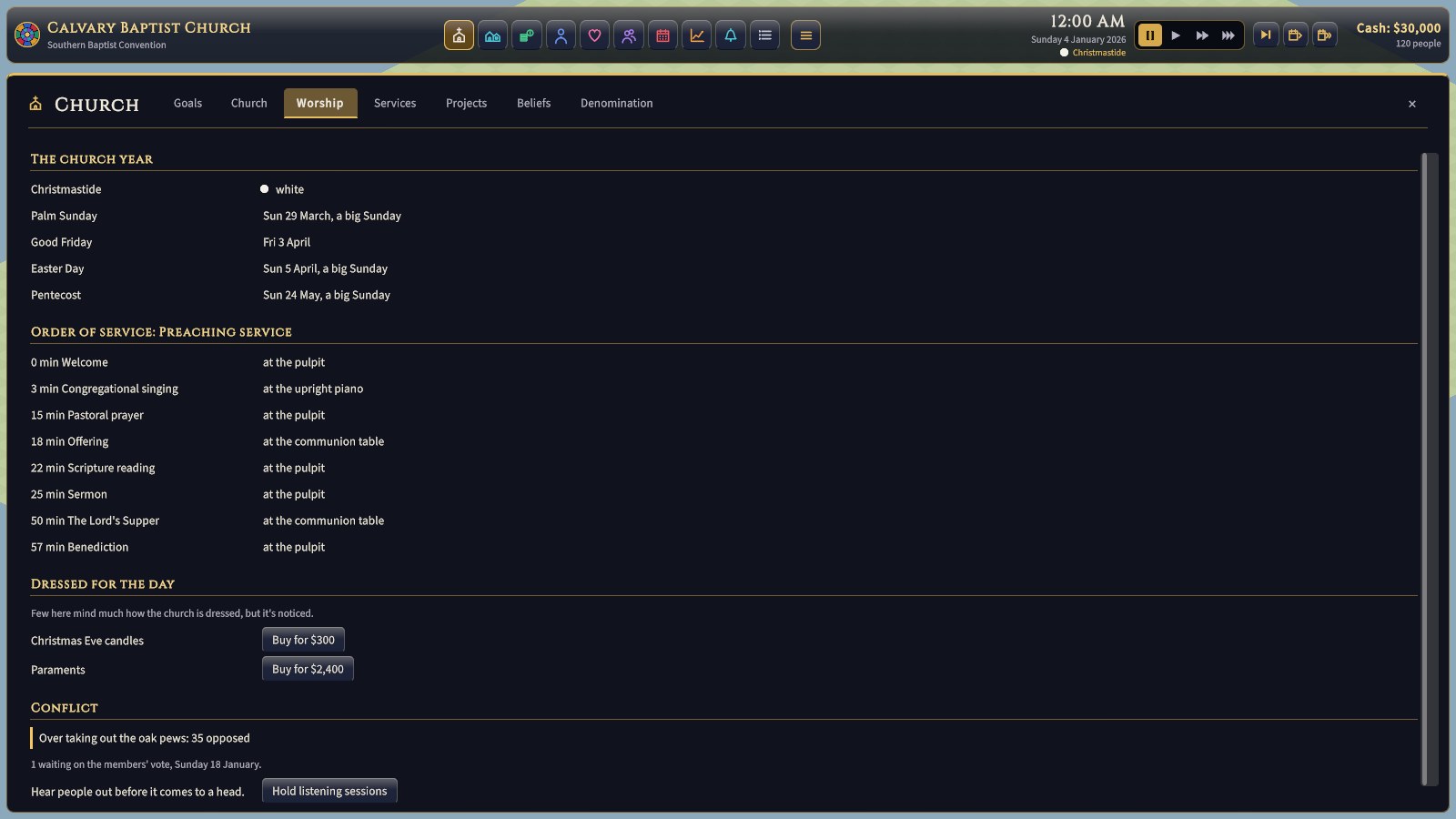
- People who have come longest oppose it most: 5% of newcomers, up to 90% of those who've come 21 years or more. The more pews go, the stronger the opposition.
- Until it's settled, opponents grumble: −0.06 after every service.
- Where the members decide renovations (the Baptists, the Assemblies of God, the Adventists, the Friends, and the other congregational churches in the table), it goes to a members' vote in two weeks. If it carries, the pews go, opponents lose 0.1, and one opposing household in ten leaves. If it fails, nothing changes.
- Where clergy or a board decide, the pews go at once. Four weeks later the opponents, never asked, lose 0.15, and one opposing household in four leaves.
Changing the seating without losing people
- Consult first. Hold listening sessions (Church → Worship, once per conflict) takes 40% off everyone's opposition.
- Do it in one go. Take out everything you mean to at once, so it's one fight, not several.
- Or don't take them out. Add chairs in new space instead.
- Change your mind. Putting everything back before it comes to a head ends the conflict.
Pews you placed yourself less than a year ago go quietly.